
Summarize Math Lectures for Students: Transcript First, 3 Minute Check
Summarize Math Lectures for Students: Transcript First, 3 Minute Check

The fastest reliable way to summarize math lectures is to transcribe first, ask an AI for a structured summary that preserves every formula and worked-example step, then spot-check the critical lines against the original recording before converting anything into flashcards. A summary is a study map, not a substitute for solving problems. If it skips a sign convention or garbles a theorem statement, it fails at the one job that matters for math.
TL;DR:
- Summarize long math lectures by transcribing, cleaning the transcript for accuracy, and breaking them into smaller segments for detailed, error-checked summaries.
- Focus the summary on definitions, formulas, and worked examples with explicit timestamps, ensuring they are copied correctly from the original lecture.
- Verify key content against timestamps within 10 to 15 seconds of audio or video to catch transcription errors before trusting the summary.
- Use AI prompts that emphasize grounding in the source material and limit the number of formulas and definitions to prevent inaccuracies.
- Convert summaries into flashcards and practice problems to reinforce learning through active recall rather than passive review.
Table of Contents
- How Do You Summarize a Math Lecture Step by Step?
- Making Transcripts Safe for Formulas and Notation
- What Should a Math Summary Actually Include?
- Which AI Prompts Keep Math Summaries Accurate?
- How Do You Verify an AI Summary Before Trusting It?
- Turning Summaries Into Flashcards and Practice Problems
- What About Multi-Hour Lectures or Classes You Can’t Record?
- When a Summary Isn’t Enough
- Try an Automated First Pass Before You Build Notes by Hand
- Sources
- FAQ
How Do You Summarize a Math Lecture Step by Step?
Treat this as a pipeline, not a single prompt. Each stage catches errors the previous one might have introduced, which matters more in math than in almost any other subject, since one dropped negative sign changes the entire meaning of a result.
- Get a transcript. Pull captions from the lecture platform if they exist, run an automated transcription tool, or transcribe manually for short clips. A transcript-first workflow reduces the odds of an AI model inventing details that were never actually said.
- Clean the technical language. Fix obviously misheard variable names, restore minus signs autocaptions tend to swallow, and flag anywhere the professor says “as you can see on the board” so you know a visual reference is missing from the text.
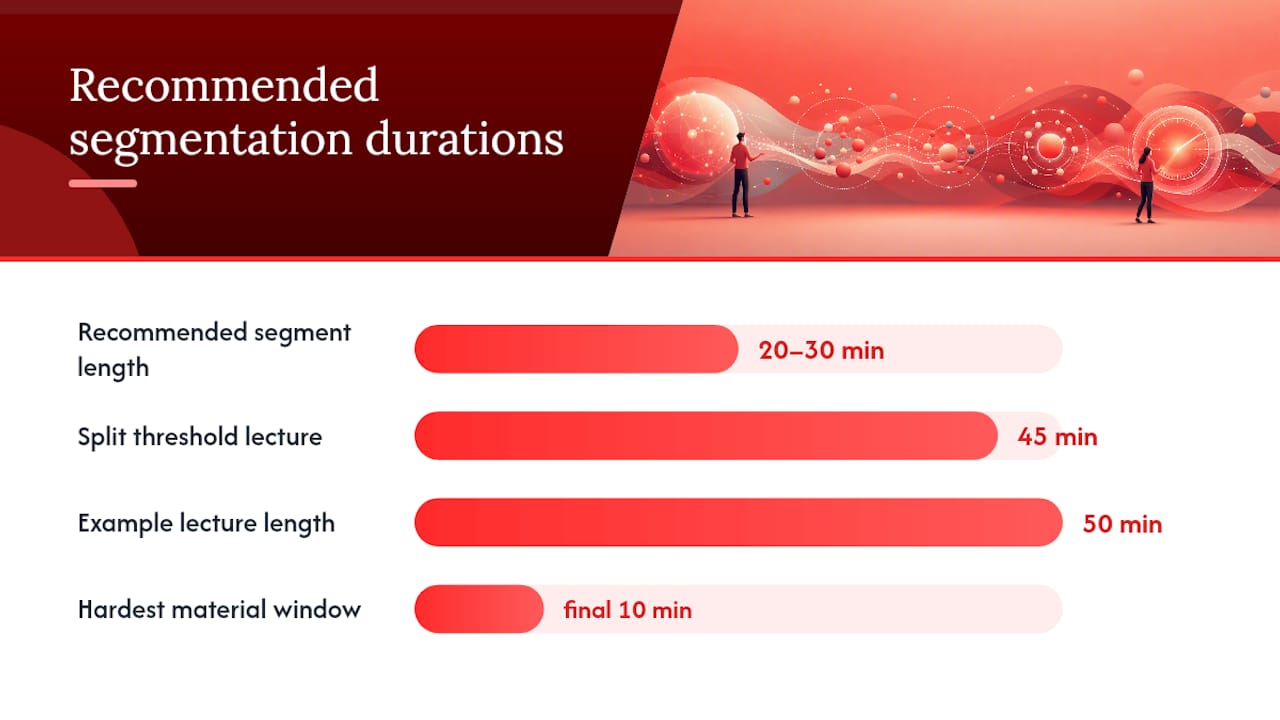
- Break long recordings into blocks. For anything over 45 minutes, split the transcript into 20 to 30 minute segments before summarizing. Summarizing block by block and then merging the results keeps early material from getting compressed into vague filler once the model starts working through later, denser sections.
- Summarize each block, then consolidate. Ask for a structured pass on each segment first: headings, key definitions, a formula block, and worked examples with numbered steps. Merge the blocks into one master outline afterward, checking that no unique formula or definition from an earlier block got dropped in the merge.
- Verify the load-bearing lines. Definitions, theorem statements, and formulas get checked against timestamps before you trust them for review.
Pro Tip: Do the block split even for a single 50-minute lecture. AI summarizers tend to thin out toward the end of long inputs, and a lecture’s hardest material often lands in the final ten minutes.
The output of this process should look less like an essay and more like a reference sheet you’d tape inside a binder. Anything that reads like a paragraph-heavy recap instead of a scannable outline needs another editing pass.
Making Transcripts Safe for Formulas and Notation
Regular lecture transcripts tolerate small transcription errors just fine. Math transcripts don’t. A missed subscript turns $x_$1 into $x$, a dropped exponent turns a quadratic into a linear equation, and autocaption software routinely renders spoken math as nonsense strings of words. Tools built for extracting formulas from technical audio exist specifically because generic transcription wasn’t built for this problem.
Before you hand a transcript to an AI summarizer, run this cleanup pass:
- Fix variable names the transcription tool clearly misheard (common substitutions: “n” for “and,” “sci” for “psi,” “delta” transcribed as “Delta” losing its lowercase meaning).
- Restore minus signs and exponents that autocaption tools frequently drop or garble.
- Mark every “as shown on the board” or “see the slide” moment so you know a visual step is missing from the text alone.
- Keep LaTeX formatting intact wherever the source already provides it rather than letting a summarizer flatten it into plain text.
- Search-and-replace common patterns: spelled-out Greek letters, “over” for fraction bars, “hat” or “bar” notation lecturers say aloud.
Pro Tip: Snap a phone photo of the board at the end of any segment with heavy notation. A five-second photo saves you ten minutes later trying to reconstruct what “the thing on the left side” referred to.
For lectures with dense board work, note the timestamps where diagrams or multi-line derivations happen. You’ll want those images next to the text summary, not as a replacement for it.
What Should a Math Summary Actually Include?
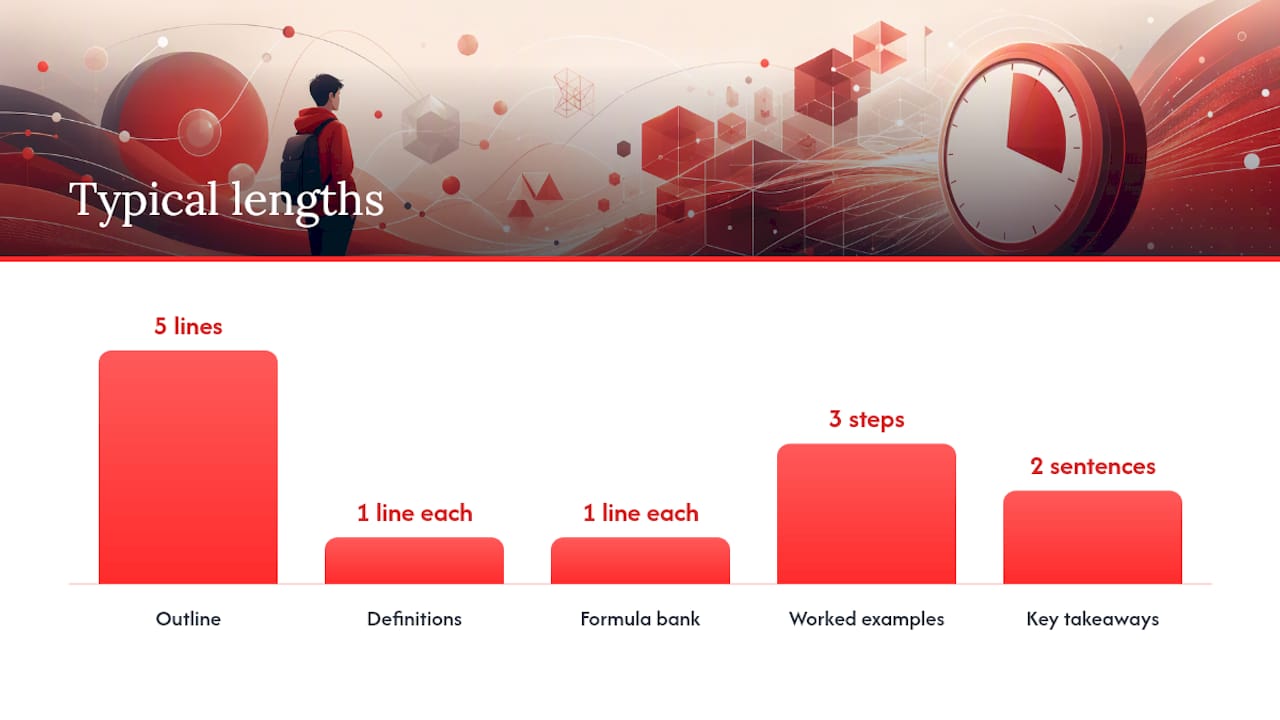
A useful math summary isn’t a shorter version of the lecture. It’s a different document with a different purpose: fast lookup during problem sets, not narrative recall. That means format matters as much as content.
Six elements belong in almost every math summary:
- A hierarchical outline of topics in the order they were taught, not reorganized by “importance.”
- A definitions block, one line each, in the lecturer’s actual phrasing where precision matters.
- A formula bank, separated from prose, so it functions as a lookup table during timed practice.
- Worked examples with numbered steps and a one-line rationale attached to each step.
- Key takeaways: two or three sentences on what the lecture was actually trying to teach.
- Timestamps next to every definition, formula, and worked example for later verification.
Worked examples deserve the most care. Write “Step 3: Factor the quadratic (uses the pattern from Step 1)” rather than a wall of algebra with no labels. That one-line rationale is what turns a worked example into a retrieval-practice item later, since you can cover the solution and try to reproduce the reasoning, not just the arithmetic.
For compression, a rough one-eighth guideline works for a 90-minute lecture: aim for roughly 10 to 12 minutes’ worth of reading material. Dense proof-heavy lectures need more room; a lecture that’s mostly worked examples compresses further, since the structure repeats.
| Section | Purpose | Typical length |
|---|---|---|
| Outline | Topic sequence and structure | 5 lines |
| Definitions | Precise terminology | 1 line each |
| Formula bank | Lookup table for practice | 1 line each, grouped by topic |
| Worked examples | Numbered steps with rationale | 3 steps per example |
| Key takeaways | What the lecture was actually about | 2 to 3 sentences |
Which AI Prompts Keep Math Summaries Accurate?
The single biggest failure mode in AI-generated math summaries is confident invention: a model fills a gap in the transcript with something plausible-sounding instead of flagging the gap. The fix is instructing the model to stay grounded, explicitly.
- Set the source-grounding rule up front. Something like: “Only use information in this transcript. Preserve every formula and LaTeX expression exactly as written. Attach a timestamp to every formula, definition, and theorem statement.” This single instruction cuts down on fabricated detail more than any other change you can make.
- Summarize in blocks, then merge separately. Run one prompt per 20 to 30 minute segment, then a second “consolidate” prompt that explicitly asks the model to check for and preserve any formula or definition unique to one block.
- Extract worked examples on their own pass. Ask directly: “List every worked example as numbered steps, with a one-line reason for each step.” Bundling this into a general summary prompt tends to produce vaguer output than isolating it.
- Request evidence lines for anything uncertain. A spot-check prompt like “Show me the exact transcript lines that mention the chain rule” turns a vague worry into a 10-second confirmation.
Pro Tip: Add a hard compression limit to your prompt, like “keep the formula bank under 15 entries.” Without a limit, models tend to either over-summarize dense sections or pad thin ones to match a length they’ve decided feels right.
How Do You Verify an AI Summary Before Trusting It?
Budget three minutes, not thirty. Verification only works if it’s fast enough that you actually do it every time, and math lectures have a small set of items that carry almost all the risk of error.
Check these first, in order:
- Every formal definition, word for word against the lecturer’s phrasing.
- Every theorem or rule statement, especially conditions attached to it (“only when n is positive”).
- Every formula in the formula bank, checking signs and exponents specifically.
- Any numerical result from a worked example.
- Sign conventions, since these are the single most common casualty of autocaption errors.
Jump straight to the timestamp attached to each item and listen to 10 to 15 seconds around it. That’s usually enough to confirm or catch an error. If something looks off, use a micro-prompt: “Show me the transcript lines around the 42-minute mark that mention this formula.” This resolves ambiguity faster than rereading the whole summary hunting for context.
Research on summarizing in math classrooms points to a pattern worth internalizing here: summarizing works best paired with active steps, not as a passive read-through. Verification is the bridge between the two. Do it before you build flashcards, not after.
Turning Summaries Into Flashcards and Practice Problems
A summary you never act on is just a longer to-do list. The real payoff comes from converting it into material that forces recall, not recognition.
- Generate flashcards from three sources: definitions (front: term, back: definition), formulas (front: “when do you use the quotient rule,” back: the formula and its condition), and worked-example checkpoints (front: the problem setup, back: the first step only, to test whether you know where to start).
- Run retrieval drills on worked examples. Cover the solution, reproduce the steps from memory, then check against both the summary and the original transcript. This single habit does more for retention than rereading the summary five times.
- Schedule spaced reviews. A same-day pass, a three-day pass, and a one-week pass catches most forgetting before it compounds. Retrieval practice consistently outperforms passive review in math and physics specifically, unless the summarizing itself is done from memory rather than while looking at the source.
- For exam week, triage by weak spots. Skim summaries for topics you can’t explain out loud, then spend your limited time on targeted problem sets from those topics instead of full review.
Pro Tip: When you cover a worked example and get stuck, note exactly which step number tripped you up. That’s a more useful diagnostic than “I didn’t understand this topic.”
What About Multi-Hour Lectures or Classes You Can’t Record?
Some situations don’t fit the standard pipeline cleanly, and it helps to know the workaround before you’re stuck mid-lecture.
- For multi-hour lectures, the block-and-consolidate approach isn’t optional. Feeding a three-hour transcript into a single summarization pass reliably loses early detail.
- Without permission to record, capture short audio snippets of key derivations, photograph the board at natural breaks, and keep a live template open with headers for “definitions,” “formulas,” and “examples” so you’re filling structure in real time instead of writing linear notes.
- A collaborative summary session, where each student explains a different worked example to the group, surfaces misunderstandings faster than solo review. This also doubles as a check on whether your AI summary matches what actually happened in class.
- Skip summarizing altogether when you already understand the material. At that point, a summary just delays the problem set you actually need.
When a Summary Isn’t Enough
Summaries earn their place as navigation tools. They tell you where the theorem was proven, what the formula bank looks like, and which worked example to revisit. They don’t build the muscle memory that comes from solving a problem cold, staring at a blank page, and working through the algebra yourself.
Treat a strong summary as a way to reduce the time between “I don’t remember this” and “I’m now practicing the right problem,” not as a way to skip practice altogether. The workflow that actually holds up under exam pressure is the same one described throughout this piece: transcribe, structure, verify, then drill. Tools that speed up the transcribing and structuring stages, including the kind Baitless builds for video content generally, are only useful to the extent they leave more time for the drilling.
— Sergio
Try an Automated First Pass Before You Build Notes by Hand
This kind of tool can turn a recorded lecture into a structured breakdown in minutes instead of the hour or more manual note-taking usually takes, with timestamps built in so verification is a click, not a rewind. 
If your math lectures live on YouTube, whether from a course channel, a professor’s own uploads, or a study group’s recorded sessions, this class of tool automates the first two stages of the workflow above: it captures the transcript and produces a structured summary with key moments flagged, so you know immediately what’s worth rewatching in full and what you can skip. That matters most during rapid triage, when you’ve got six lecture recordings before a midterm and need to decide fast which ones actually need your full attention.
Some services give new users 25 free summary credits with no card required, enough to test the workflow across a handful of lectures before committing to anything. Heavier users, daily reviewers, or anyone working through a full course’s back catalog can move to paid plans for expanded credits. Check the Baitless pricing page to see which tier fits your study load and start your first summary today.
Sources
For checking formulas and derivations against a canonical source, MIT OpenCourseWare offers full lecture notes and problem sets across most undergraduate math courses. For a deeper look at how automated tools handle math-specific transcription challenges, see this guide on summarizing tutorial videos accurately. For adjacent workflows in video-heavy research, Voclify’s guide to AI video tools covers related automation approaches.
- Scott Eckman — action research on summarizing in math
- Classlecture
- Summarize classes & lessons with AI — VOCAP
- Is summarizing effective for learning math and physics? — Unisium
FAQ
How Do I Summarize a Lecture Effectively?
Start from a transcript rather than your memory of the lecture, then ask an AI tool to produce a structured outline with definitions, formulas, and worked examples kept separate from general narrative. Verify the highest-risk lines, like formulas and theorem statements, against timestamps before treating the summary as final.
What Are the Basic Rules of Summarizing?
The core rules are: work from the original source rather than secondhand notes, preserve technical details exactly rather than paraphrasing them, organize by structure rather than chronology, keep it short enough to scan quickly, and verify anything you’re unsure about. For math specifically, source-grounded summarization matters more than in most subjects because a single altered symbol changes the meaning.
What Are the Main Branches of Mathematics?
Most undergraduate math curricula cover algebra, calculus, geometry, statistics and probability, and discrete math (including logic and combinatorics), though course sequences vary by program. Lecture summaries typically inherit whichever branch the course covers, since formula banks and notation conventions differ significantly between, say, calculus and discrete math.
What Is an App That Can Summarize Lectures?
Baitless is a Chrome extension built for summarizing recorded video content, including math lectures hosted on YouTube, producing a structured breakdown with key moments flagged so you can decide what to rewatch. It offers 25 free summary credits with no card required, with a Pro plan at $7.99 per month for heavier use, detailed on the Baitless pricing page.
How Long Should a Math Lecture Summary Be?
A rough guideline is about one-eighth the length of the original lecture in reading time, so a 90-minute lecture might compress to 10 to 12 minutes of review material. Denser, proof-heavy lectures often need more space, while lectures built mostly around repeated worked examples compress further.